
Point 6 – Heritage
A World in Transition
A World in Transition
You’ve reached the final stop on the Multicultural Trail.
Having explored Biertan through its houses, lanes, crafts and vineyards, we now shift the view from place to time.
The world you have glimpsed along the trail endured for centuries. The 20th century, however, transformed Biertan more quickly and more profoundly than almost any other period before it.
Both World Wars left deep marks on the community. The aftermath of the Second World War was one of the most difficult periods in the history of the Transylvanian Saxons.
In January 1945, ethnic Germans deemed fit for work started being deported to the Soviet Union. 147 people from Biertan were deported. 12 of them never came back.
That same year, the land reform also changed rural life profoundly. Many residents lost their land, livestock and farming equipment. The Saxon community was among the most heavily affected.
Nationalisation and subsequent collectivisation radically changed the traditional organization of the households. For a community where private property – the land, the vineyard, the household and the workshop – had been an essential element of family life for generations, the change was life-changing.
Yet some parts of the old community structure survived. The neighbourhoods you encountered earlier continued to function after the war, adapting to the new circumstances. People still helped one another at funerals, cared for the cemetery, worked together for the church and the wider community, and counted on the neighbourhood network to pass around important information.
In the 1950s and 1960s, Saxon neighbourhoods were still strong mutual-aid groups – organised enough to be recognised, used and respected even by the state authorities. As late as 1984, nine Saxon neighbourhoods were still active in Biertan.
The old community structure did not vanish overnight. It weakened gradually, as village life itself changed.
The world of the old craftsmen also faded. Traditional trades lost the role they had once played in the local economy. But the most dramatic demographic shift was still to come: the departure of the Saxons.
Emigration to Germany had begun during the communist period, and intensified in the final decades of the regime. After 1990, when the borders were opened, it increased on an entirely different scale. In just a matter of years, most of the Saxon community in Biertan had left – most people going to Germany.
These changes did not affect just the Saxons. As with many other rural communities across Romania, some Romanian residents also moved to towns and industrial centres, looking for jobs and a different way of life. In a very short amount of time, a community that had built and inhabited this space for centuries shrank dramatically.
The houses remained. So did the church, the lanes, the gates, the cellars and the terraced hills. But fewer and fewer of the people who had built them were still here.
As people started leaving, the old neighbourhood networks that had held this community together for generations weakened, too. Biertan started a new life chapter.
After 1990, the village’s heritage came to be seen not only as a record of the past, but also as a resource for the future. Its ties with the Saxons who had left were never completely broken, and so reunions in Biertan became a way for those people to stay connected to their native village.
In 1993, Biertan and its fortified church were included on the UNESCO World Heritage List. The designation was later extended to include a wider group of Transylvanian villages with fortified churches.
Biertan today is once again a diverse community, although its structure has changed. Romanians make for the majority of the population, alongside a significant Roma community, Hungarians and a Saxon community a lot smaller than it used to be. Long-established local families now share the village with new-comers, with Saxons and their descendants who return here from time to time, but also with visitors from around the world. In a different way from medieval Biertan, this is still a place where people and cultures get to meet.
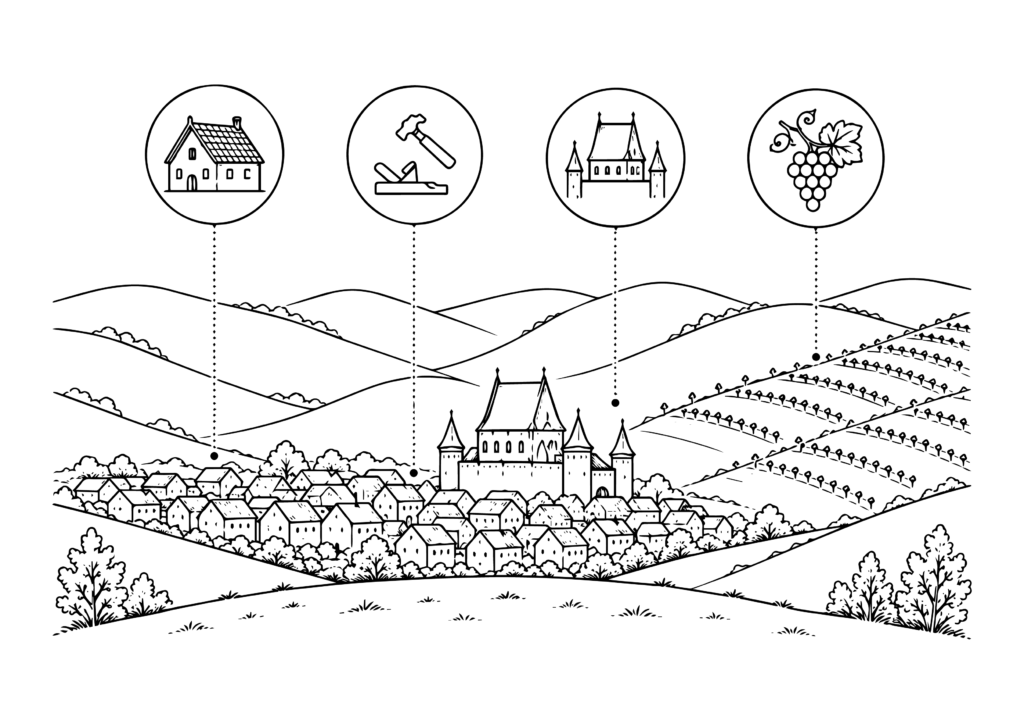
From here, if you look back over the village, the whole trail comes together.
The fortified church stands in the centre of the village, with houses and lanes gathering around it. The hills where vineyards once grew rise beyond them. And somewhere among all of this, there were the craftsmen’s workshops, the guilds and the neighbourhoods that kept the community connected.
The trail ends here. The story of Biertan does not.
It goes on with the people who live here today, but also those who return, and those who, just like you, are arriving here for the first time.
If you enjoyed this story, pass it on. Tell others about Biertan and invite them to come and experience it for themselves. We are happy to welcome them.
The Biertan Multicultural Trail is part of the project „Equipping and digitalizing the tourist infrastructure of Biertan commune”, a project funded through European funds under the National Recovery and Resilience Plan (PNRR), Component C11 – Tourism and Culture, Reform R1 – Operationalization of Destination Management Organizations (DMO).