
Point 4 – Guilds
Craft and Community
Craft and Community
You’ve reached Point 4 of the Multicultural Trail. By now you have seen how the village of Biertan grew and how successive communities left their mark on it. But a medieval market town could only prosper if it had people who could make, build and repair things.
In the Middle Ages, Biertan was one of the region’s leading craft centres, rivalling nearby Mediaș. By the early 16th century, 19 guilds were active here, representing 25 different trades.
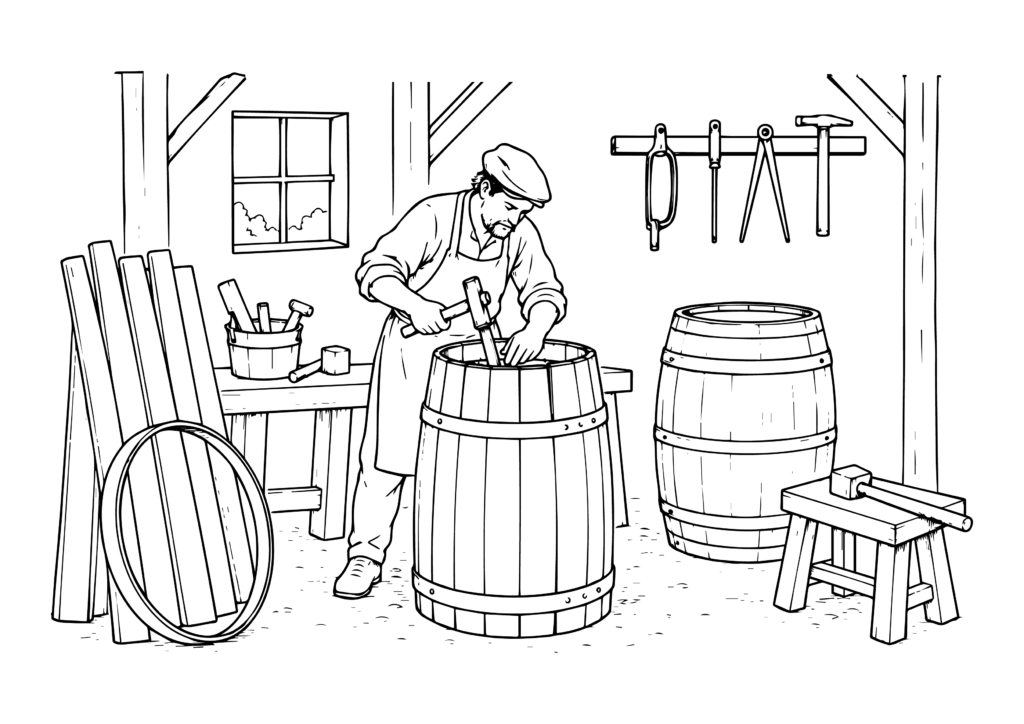
Blacksmiths, tailors, shoemakers, weavers, potters, carpenters, wheelwrights and coopers belonged to a world in which almost every object of daily life had been shaped by the hands of a skilled craftsman.
A guild, however, was far more than a mere association of people in the same line of work.
The guild determined who could become a master, how work was to be carried out and what quality standards their products had to meet. Training began with the apprenticeship, which could last three to five years. It was followed by the journeyed period, and only after additional years of work and learning one could finally achieve the status of a master.
Guilds also regulated the conduct of their members. They had their own rules, leaders, funds and symbols. They took part in the religious life and community defence, and also supported members in times of need. Common funds provided help in case of illness or death, as well as support for the craftsmen’s widows and children.
One of a guild’s most important possessions was the chest. It held statutes, registers, money and seals. Two different leaders kept the two keys, so the chest could only be opened when they were both present. It was also next to the guild’s chest that new apprentices were officially admitted as members, journeymen’s work was assessed and major decisions were made.
In a system like that, one’s trade meant more than simply mastering a set of skills. It also involved discipline, responsibility and the feeling of belonging to a community.
Of all the trades in Biertan, one in particular was closely tied to the wealth growing on the surrounding hills.
Go on to Point 5, where the story turns to the vineyards, the wine and the craftsmen who made its storage possible: the coopers.
The Biertan Multicultural Trail is part of the project „Equipping and digitalizing the tourist infrastructure of Biertan commune”, a project funded through European funds under the National Recovery and Resilience Plan (PNRR), Component C11 – Tourism and Culture, Reform R1 – Operationalization of Destination Management Organizations (DMO).