
Point 2 – Houses
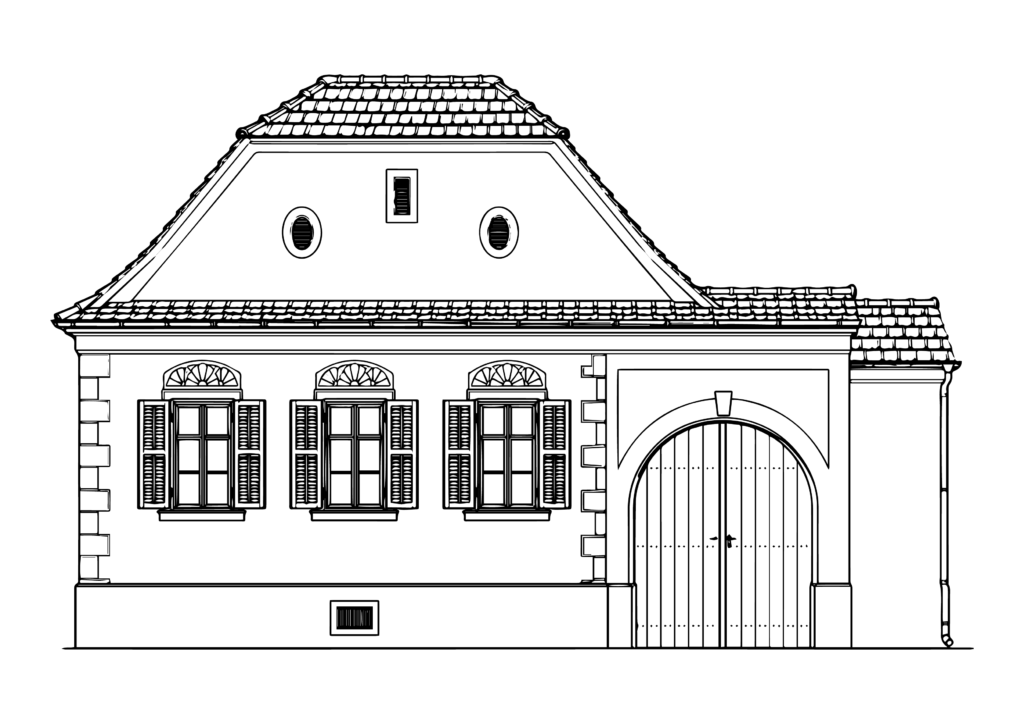
Houses of Biertan
The Houses of Biertan
You’ve reached your second stop on the Multicultural Trail. At the first one, you learned how Biertan grew into a prosperous market town. Here, the houses themselves tell you the story.
You are now on Horea Street, formerly Untere Quergasse (Ulița Mălaiului, aka Corn Flour Lane). As you walk on, watch the rows of houses and see if you can spot the differences between the Saxon and Romanian houses in their architecture.
The earliest Saxon homes in Biertan were modest dwellings largely made of wood, with thatched roofs. As the market town prospered due to farming, winegrowing, crafts and trade, its houses changed, too. Stone foundations appeared from the 15th century onwards, and timber was gradually replaced by brick as a construction material. The farmsteads that look so familiar today mainly took shape from the late 18th century into the first half of the 19th, as older wooden buildings gave way to stone and brick structures.
Notice the way the street is built up: the houses stand close together, their narrow sides and gables facing the road. High walls and gateways close off the farmstead, separating the family’s private space from the public space of the street. Also behind the gate were the yard and outbuildings – stables, barns and storage structures. This pattern, typical of Transylvanian Saxon villages, has survived remarkably well in Biertan.
Some houses also reveal what their owners did for a living. In a region once known as the Weinland – ‘The Wine Country’ – cellars sometimes opened directly onto the street, so barrels could be moved around more easily. Prosperity was also visible on the façades, displayed in the shape of oval dormer windows, medallions, decorative surrounds and floral or plant motifs – at times, almost like a quiet competition between neighbours.
Biertan, however, was never just a Saxon village. Romanians had long been present here: at first, mainly as shepherds and agricultural workers, but their numbers grew from the 17th and 18th centuries onward. A census in 1715 already recorded 34 Romanian householders, with their community steadily expanding in the decades to follow.
The changing population gradually left its mark on the village itself. Construction works for the Orthodox church began in 1799. A Greek Catholic community also emerged in the 19th century, building its own church in 1856. By then, the diversity of Biertan was visible in its housing, too: a record from 1819 lists 247 Saxon houses and 70 Romanian ones. Roma and Boyash families were also present, living mainly towards the outskirts of the village.
Walking through Biertan today, you can see more than just some old houses. You can actually notice the traces left by several communities, each of them adding a new layer to the richness and diversity of their village.
People were connected not only because they lived in neighboring houses or on the same street. The life of the community was also organised based on a centuries-old system of groups known as the ”neighbourhoods”. That is where the next stop takes us.